
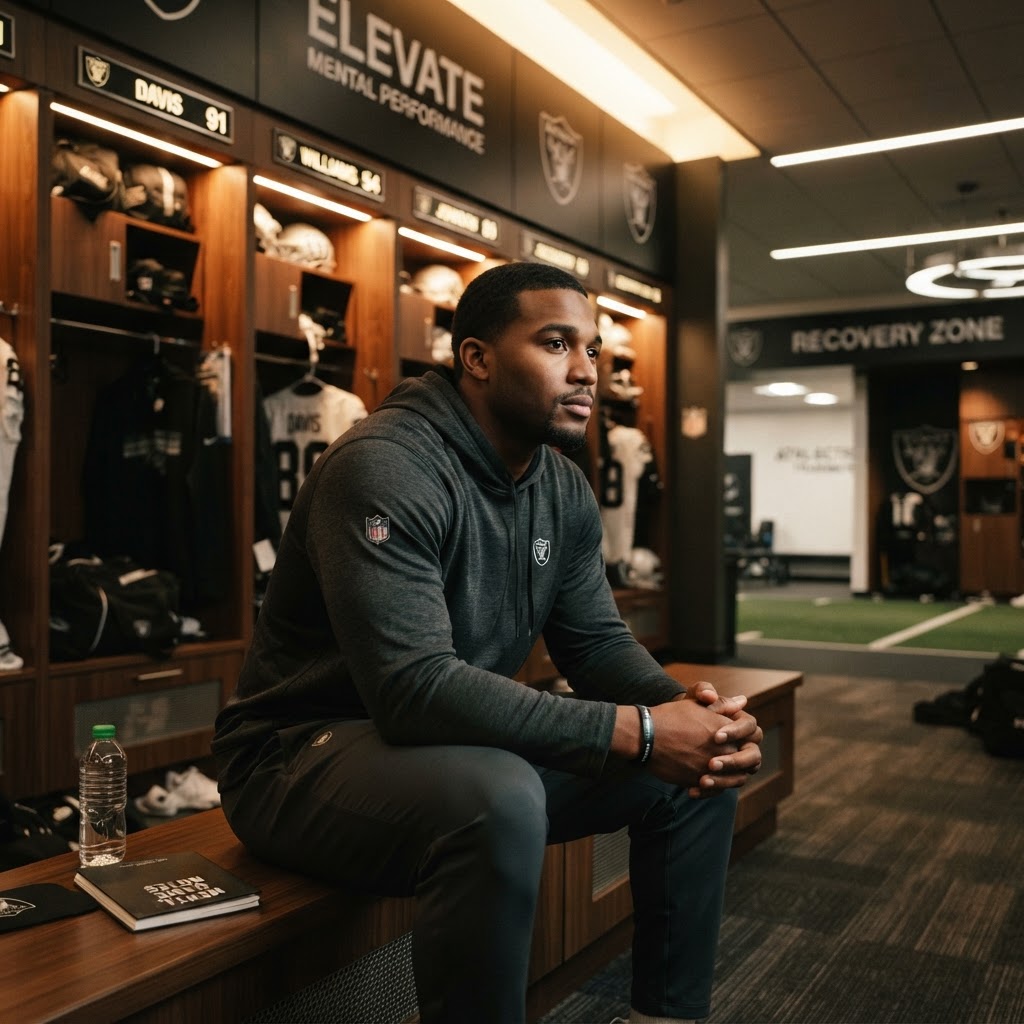
The first time I walked into an NFL locker room as the team clinician, I expected to feel out of place.
I didn't.
What surprised me wasn't the environment. It was how familiar the pain was.
Five years. That's how long I spent embedded inside a professional NFL organization, working directly with players, coaches, staff, and their families as the team's mental health clinician.
I've sat with players the night before games that would define their careers. I've talked with veterans processing what it means to be cut after ten seasons. I've worked with rookies who had every physical tool in the world and couldn't sleep because the mental weight of expectation was crushing them.
What I learned in those five years fundamentally changed how I think about mental performance, and more importantly, what I think the sports world still gets dangerously wrong about it.
The Biggest Misconception
Everyone assumes professional athletes have the mental game figured out.
They don't.
In fact, the higher the stakes, the more sophisticated the emotional challenges become. The athletes who were struggling weren't struggling because they lacked mental toughness. They were struggling because they were carrying emotional weight that no one had ever given them the tools to process.
Pre-game anxiety that had become chronic. Identity so fused with performance that a bad game felt like a referendum on their worth as a human being. Relationship strain from months of travel and scrutiny. The creeping sense that the version of themselves their fans saw had nothing to do with who they actually were.
This is not weakness. This is what happens when you take a human being, place them inside an elite performance machine, and remove almost every normal support structure in the process.
What Changes When You're Actually in the Room
Reading about mental health in professional sports is very different from being inside it.
What the research doesn't capture: the silence.
The culture of elite sports, especially at the professional level, has historically treated emotional expression as vulnerability and vulnerability as liability. Players learn early that showing struggle is not safe. Coaches learn to project certainty even when they're drowning. The entire system optimizes for performance output, and the internal human experience that drives that output is treated as secondary.
What I saw, over and over, was the cost of that silence.
Not dramatically. Not in obvious breakdowns. But quietly, in the slow erosion of someone's capacity to perform at their real ceiling, because they were managing unaddressed emotional weight at the same time they were trying to compete at the highest level.
The athletes who broke through that ceiling weren't the ones with the most talent. They were the ones who did the internal work.
What This Means Outside of Sports
I don't only work with professional athletes. I work with executives, high-achieving professionals, and high-achieving women who are navigating the same dynamics in different arenas.
The stakes are different. The uniforms are different. But the core challenge is remarkably similar: How do you perform at your highest level when no one is teaching you to manage the emotional architecture underneath that performance?
The executive who can't sleep the night before a board presentation. The attorney who is technically excellent and chronically exhausted. The woman who has built exactly the career she wanted and still feels like something is missing.
This is not a sports problem. It's a high-performance problem.
And it's far more solvable than most people realize.
What I Carry Out of That Locker Room
I carry the specific knowledge of what it looks like when someone finally does the work.
Not the inspirational version of that story. The real version.
The player who showed up to sessions not because he believed it would help, but because his wife asked him to try. And three months later told me it was the best decision of his season.
The coach who had been running at 110% for twenty years and had never once been asked how he was doing. Not by his staff. Not by the organization. And certainly not by himself.
The rookie who learned, for the first time, that his identity didn't have to be synonymous with his statistics.
Those are the moments I carry.
And they are exactly why I do what I do now, helping athletes, executives, and high-achieving professionals build the mental infrastructure that their environments never gave them.